
Managing Risk in the Modern Healthcare Ecosystem: Why Today’s Cybersecurity Strategies Must Start with Patient Safety
Introduction: The Digital Care Dilemma
Hospitals today are more connected than ever. Data flows in real time across systems that manage clinical workflows, medical devices, and patient experiences. But that same connectivity creates a critical dependency: when digital systems fail, care delivery can grind to a halt.
The stakes are no longer theoretical. These are not hypothetical breaches — they’re real-world incidents that delay surgeries, expose sensitive patient data, and erode trust. In today’s landscape, cybersecurity is clinical.
At CloudWave, we believe modern risk management must be rooted in this reality. The convergence of Information Technology (IT), Operational Technology (OT), and care delivery demands a new kind of strategy — one designed not just to protect networks, but to preserve patient outcomes.
Healthcare’s Expanding Attack Surface
Let’s start with a clear-eyed look at the threat landscape.
Healthcare remains the #1 most-targeted industry for cyberattacks — and for good reason. Hospitals house vast volumes of sensitive data, rely heavily on uptime, and often operate with limited cybersecurity resources. Threat actors know this, and they’re exploiting it.
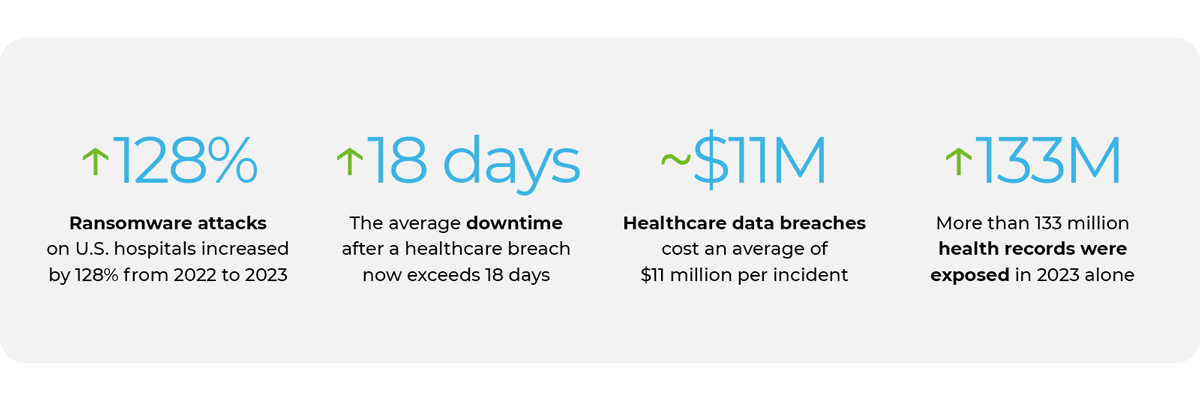
Recent data underscores this growing risk:
- Ransomware attacks on U.S. hospitals increased by 128% from 2022 to 2023¹
- The average downtime after a healthcare breach now exceeds 18 days²
- Healthcare data breaches cost an average of $11 million per incident — the highest of any sector³
- More than 133 million health records were exposed in 2023 alone — a 170% increase from 2022⁴
The implications go far beyond financial loss. Cyber incidents have directly delayed care and, in some cases, contributed to adverse patient outcomes — even fatalities. This isn’t just about stolen data. It’s about compromised care.
The IT/OT Convergence Challenge
Historically, healthcare organizations separated IT systems (email, EHR, admin tools) from clinical and operational technology (infusion pumps, imaging devices, lab systems). But in today’s environment, those lines no longer exist.
Modern IT/OT convergence means:
- Medical devices are network-connected, not standalone
- EHRs and lab systems are increasingly cloud-hosted and third-party managed
- Data moves between legacy on-prem systems and modern SaaS tools
- Clinical workflows rely on uninterrupted digital connectivity
This complex web has created a sprawling — and often poorly understood — attack surface. A compromise in one system can rapidly cascade across others. Worse, many hospitals lack full visibility into their OT environment, making detection and response even harder.
The result: risk is everywhere, and often invisible until it’s too late.
Beyond the Firewall: A New Model of Risk Management
Perimeter defense and static tools aren’t enough. A modern threat landscape requires a holistic, adaptive, and care-centric approach to cybersecurity.
A modern healthcare risk management model includes:
- Proactive Threat Identification: Leverage behavioral analytics and threat intel to anticipate attacks — not just react.
- Clinical Context Awareness: Prioritize systems based on care impact. ADT feeds may matter more than email uptime.
- Real-Time Monitoring & Response: AI-driven MDR services help identify lateral movement and contain threats faster.
- Full-Spectrum Visibility: Map and monitor assets across IT, OT, cloud, and IoT — including PACS, pumps, and portals.
- Compliance-Embedded Frameworks: Align with HIPAA, HICP, and NIST CSF from day one — not as an afterthought.
It’s not about adding more tools. It’s about orchestrating a smarter strategy that bridges clinical operations and cybersecurity defense.
CloudWave: Built for Healthcare, Tuned Into Risk
At CloudWave, we’ve spent over a decade working shoulder-to-shoulder with hospitals. We’ve walked the halls, studied workflows, and participated in clinical risk committee meetings. We understand that EHR uptime isn’t just a KPI — it’s a care mandate.
As a healthcare-focused MSSP, our cybersecurity services are designed to align with real-world hospital operations — across legacy environments, cloud platforms, and connected medical technologies.
Our Capabilities Include:
- Managed Detection and Response (MDR): Custom-tuned to cut through noise and prioritize care-critical threats.
- Rapid Incident Response: Rooted in clinical urgency, with playbooks built to preserve uptime for vital systems.
- Risk & Compliance Assessments: Actionable insights across IT, OT, and clinical workflows — not just checkbox compliance.
- Security for Converged Ecosystems: Full-stack protection for EHRs, PACS, med devices, IoT, and cloud-native systems.
We’re not just another MSSP. We’re a healthcare cybersecurity partner who understands downtime protocols, accreditation requirements, and the operational pressures of care delivery.
The New KPI: Care Continuity
In healthcare, cybersecurity success isn’t just measured in blocked threats or patched endpoints. It’s measured in clinical continuity.
Ask this: Can your hospital deliver safe, uninterrupted care in the face of cyber disruption?
Hospitals that adopt this mindset — and align their security strategy accordingly — will be the ones that earn community trust, secure executive buy-in, and protect patient safety.
A Call to Action for Healthcare Leaders
Cybersecurity is no longer just a CISO’s concern. It’s a strategic imperative for CIOs, CMIOs, CFOs, and operational leadership.
Cyber risk is care risk.
At CloudWave, we help hospitals transition from reactive defense to resilient, care-aligned protection. Let’s build a risk strategy that puts patients first.
Talk to CloudWave’s experts about your risk posture

— Clay Sides, Sr. Technical Principal
References
1. Emsisoft. The State of Ransomware in the US: Report 2024. https://www.emsisoft.com/en/blog/44115/the-state-of-ransomware-in-the-us-2024/
2. Ponemon Institute. Cost of a Data Breach Report 2023. IBM Security.
3. Ibid.
4. HIPAA Journal. 2023 Healthcare Data Breach Report. https://www.hipaajournal.com/2023-healthcare-data-breach-report/