
Beyond the Checklist: How to Run Successful Tabletop Exercises That Truly Test Your Organization’s Resilience
Many healthcare IT security leaders treat a tabletop exercise or incident response training like a static compliance requirement: it’s scheduled once a year, everyone shows up because they have to, and they leave feeling like they “checked the box.”
But when a real incident hits at 2:00 AM, a checked box won’t ensure uninterrupted patient care. If your incident response training feels like a hypothetical brainstorming session rather than a rigorous stress test of existing protocols, your team is engaging in a theoretical exercise rather than building operational resilience.
A primary function of a tabletop exercise is to test whether the organization can handle a security incident using actual organizational processes. If these processes aren’t followed, the exercise can’t accurately evaluate capabilities and exposes risks beyond a failed exercise, including delayed and inadequate response with increased patient care, technical, financial, and legal impacts.
The High Cost of “Good Enough”
When a facilitator asks, “What would you do?” and the team answers, “We’d probably do X,” rather than referring to their incident response plan or other relevant process documentation, you are not truly testing preparedness. Failing to run a rigorous exercise creates measurable risk.
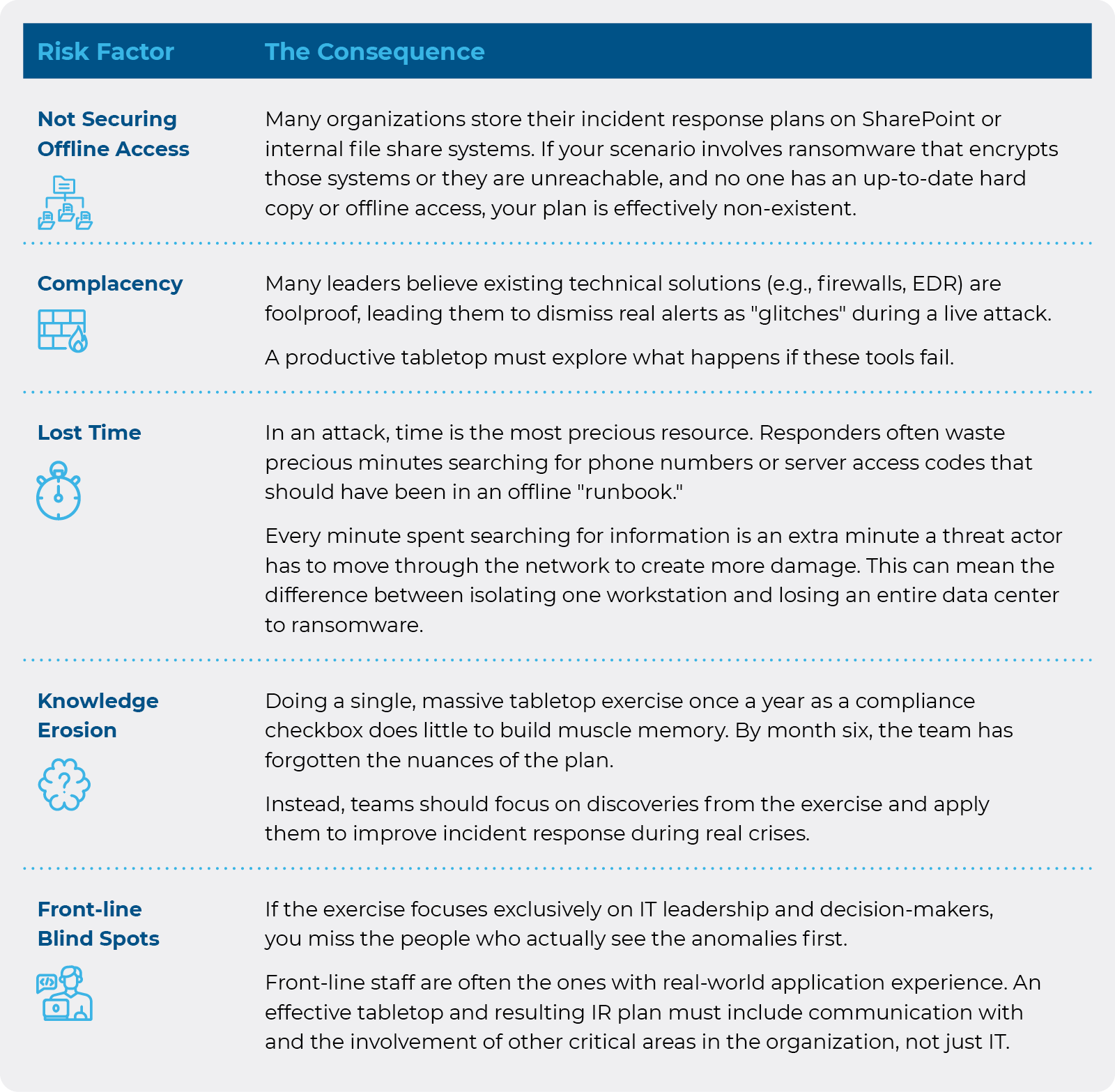
Red Flags: Is Your Incident Response Scenario Failing?
You can tell a tabletop is missing the mark when it feels like a choreographed performance. Watch for these signs:
- The “Silent Room” Syndrome: If the room is quiet, you either have the wrong people in the room, or you haven’t created a “safe space” to make mistakes.
- The Scripted Response: If everyone knows the “right” answer because the scenario was leaked or is too predictable, you aren’t seeing authentic behavior.
- No Paper Trail: If the exercise ends and no one is assigned to update incident response documentation based on discovered gaps, the session was not a true training event.
Building A Better Playbook
There is no wrong way to run tabletops, but they can be more efficient and impactful. To move beyond a checkbox exercise, shift from simply testing plans to fostering active engagement and practical application. The best approach adds energy, structure, and openness beyond technical planning.
Give the participants the freedom to let the facilitator know when an existing safeguard, process, or solution would ‘catch’ the threat in the exercise. When a participant says, “Our antivirus would catch that,” don’t argue. Instead, say: “Great. It should. But for this exercise, it didn’t. Now what happens? How does that change your next move?” This forces the team to look past their safeguards and test their manual processes and communication chains.
Modernize Your Structure
Large, annual, all-hands meetings are often the least effective way to conduct incident response training.
- Include the Right People: Avoid front-line staff blind spots.
- Gamify the Experience: Use interactive scoring or small, non-monetary rewards (like a high-end mouse or keyboard) to incentivize participation.
- Focus on Frequency: Instead of one four-hour marathon session per year, try shorter “micro-tabletops” every quarter, focused on specific departments or regions.
- Draft the Templates Now: Don’t let your first time writing a “Company-Wide Ransomware Notification” be at 2:00 AM under duress. Use the tabletop to finalize pre-approved communication templates.
Validate the Wins
Tabletops are often viewed through a negative lens, as a way of finding what’s broken. However, a truly effective leader uses these sessions to reinforce what works.
Participants only get out of the exercise what they bring to it. Encouraging vocal participation ensures that the scenario remains a collaborative problem-solving effort.
Identifying a successful coordination effort or a technical defense that held up is vital. It helps the team appreciate their existing capabilities and build confidence, while providing a blueprint for a successful response.
The Bottom Line
A tabletop is a unique, no-fault window of opportunity. It is much better to ask a “silly” question or find a broken link in the chain during a drill than to discover it when patient care is on the line.
You can plan and execute tabletops on your own, but it may be best to bring in experts to provide perspective.
CloudWave brings something internal teams can’t replicate to tabletop exercises: a threat picture built across hundreds of real incidents, no organizational blind spots or hierarchy to navigate, and a clear benchmark for what good actually looks like in healthcare environments. We design scenarios that reflect how attacks genuinely unfold and foster an environment that gets people speaking honestly under pressure. The result is a faster, more honest after-action process, and documentation that holds up if regulators come asking.

Todd Skaggs
Security Analyst
Click here to learn more about taking your healthcare organization’s tabletops to the next level.