
The True Cost of a Healthcare Data Breach: A CFO’s Financial Risk Model
Fines are the part everyone talks about. They’re also the smallest part of the bill.
 When healthcare finance leaders think about the cost of a data breach, the instinct is to anchor on the regulatory fine. It’s concrete, it’s reported in the news, and it shows up in enforcement press releases that land in our inboxes. So, when a breach produces a $500,000 HIPAA settlement, it can feel like a manageable, bounded event.
It isn’t. And the data now makes this case with considerable force.
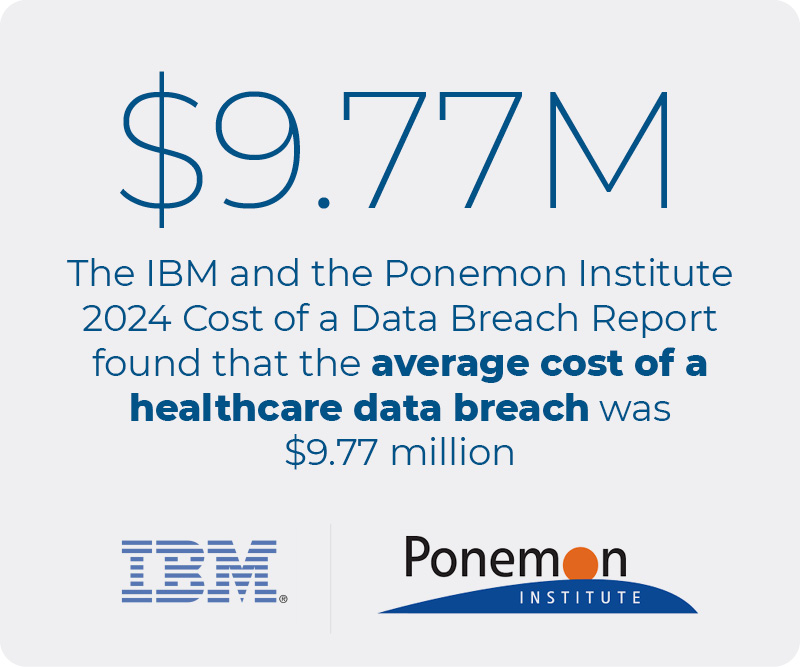
IBM and the Ponemon Institute have tracked healthcare data breach costs for over a decade. Their 2024 Cost of a Data Breach Report found that the average cost of a healthcare data breach was $9.77 million, the 14th consecutive year healthcare has ranked as the most expensive industry for breach response and recovery.¹ That is more than double the cross-industry average of $4.88 million.
The regulatory fine is rarely the line item that produces that number. As CFOs, we need to understand what does, because understanding the complete financial exposure is the only rational foundation for security investment decisions.
The fine is a rounding error
HIPAA civil monetary penalties can reach $1.5 million per violation category per year, and OCR settlements have reached as high as $16 million in the most serious cases.⁸ Enforcement activity increased in both 2024 and 2025, and state attorneys general are pursuing independent actions with growing frequency. This is not a trivial risk.
But in a significant ransomware scenario—which now represents the dominant threat vector for mid-size healthcare systems—the regulatory fine is routinely the smallest component of the total financial impact. Ransom payments themselves represent only about 15% of total breach costs; the remaining 85% accumulates across operational downtime, recovery, legal exposure, and reputational damage.⁹
The framing matters: we are not talking about the cost of a fine. We are talking about the cost of an event.
A working financial model for mid-size health systems
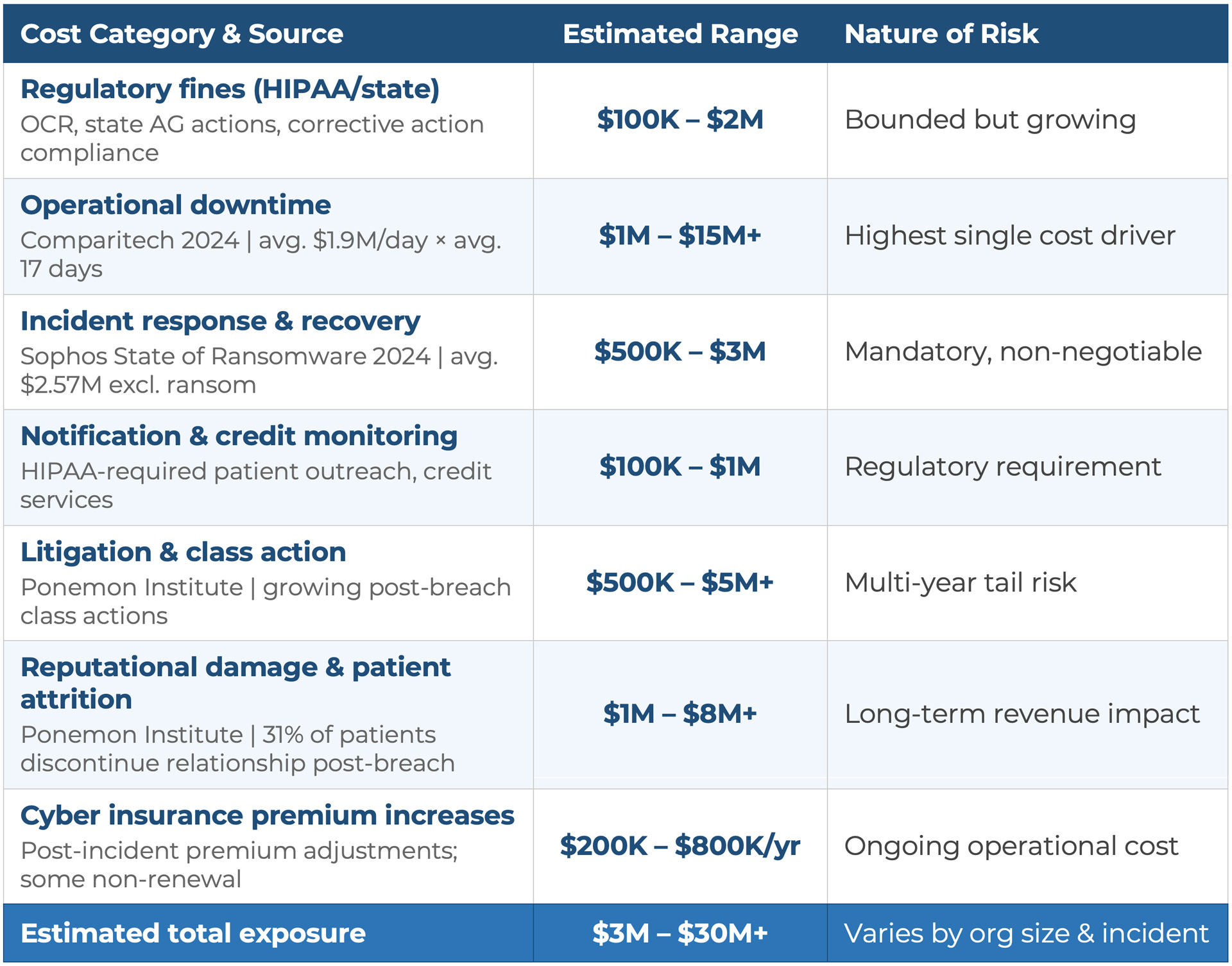
The following framework is grounded in published research from IBM, Sophos, Comparitech, and the Ponemon Institute. Full citations are included in the reference section at the end of this article. Ranges reflect variation in organizational size, incident complexity, and response readiness; treat them as a starting framework, not a ceiling.
The costs that consistently get underweighted
Operational downtime deserves far more attention in the CFO’s risk model than it typically receives. Comparitech’s analysis of 654 ransomware attacks on healthcare organizations from 2018 to 2024 found that each day of downtime costs healthcare organizations an average of $1.9 million, with organizations experiencing an average of 17 days of downtime per incident.³ At those figures, the downtime component alone can reach $32 million for a large system — and recovery is getting slower, not faster.
Sophos’ 2024 State of Ransomware in Healthcare report found that only 22% of attacked healthcare organizations recovered in less than a week — down from 54% in 2022. In 2024, 37% took more than a month to recover.² For a mid-size system operating on thin margins, a month of significant operational disruption is not an abstract risk. It is an existential one.
The reputational tail is also persistently underestimated. Ponemon Institute research found that 31% of consumers discontinued their relationship with an organization after learning it had been breached, and 65% reported a loss of trust.⁵ For healthcare providers, the relationship between data breach and patient behavior is nuanced — research indicates that patients with chronic conditions who rely on regular care are less likely to disengage, but discretionary patients and new patient acquisition are meaningfully affected.⁶ The financial implications compound over 12 to 24 months post-incident.
Then there is a cost that appears nowhere on any published data set: senior leadership time. A significant breach will consume hundreds of hours of your most senior leaders’ capacity over the months of incident response, board reporting, regulatory engagement, and public communication that follow. That is capacity not available for strategic priorities, growth, or operational improvement. It is genuinely expensive, even if it is invisible in a cost model.
Running the expected value calculation
Here is how I think about this as a finance matter.
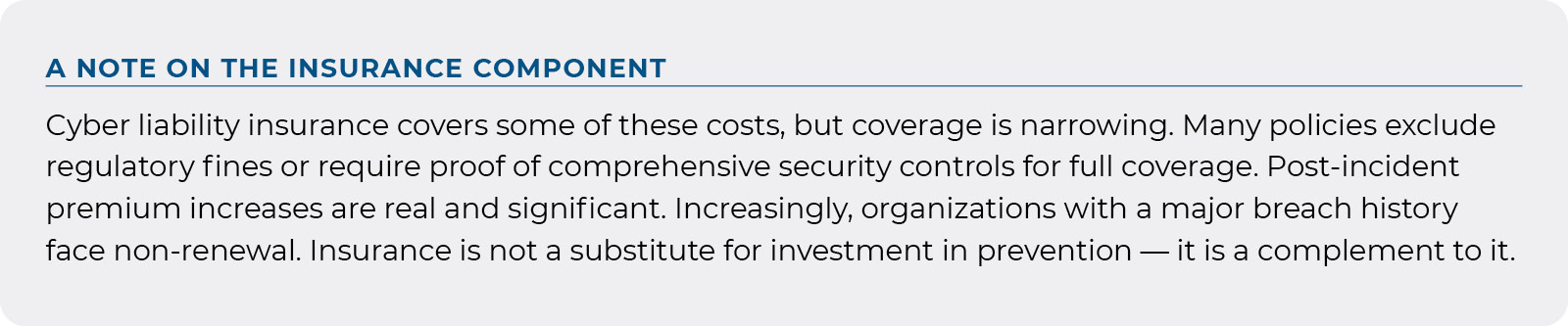
If the probability of a significant breach event over a three-year horizon is 15–20% for a mid-size healthcare system, which is conservative given that Sophos found 67% of healthcare organizations worldwide experienced a ransomware attack in 2024 alone², and the expected direct and indirect cost of that event is $4 to $10 million, then the three-year expected value of the risk is $600,000 to $2 million.
That is your baseline for evaluating security investment. Any investment that meaningfully reduces breach probability, limits the blast radius of an incident, or accelerates recovery time can be evaluated against that expected loss figure. IBM’s 2024 data found that organizations making extensive use of security AI and automation incurred an average of $2.2 million less in breach costs compared to those without.¹ That is a measurable, documented return.
This is not complicated finance. It is the same expected value logic we apply to property insurance, liability reserves, and supply chain risk. The only reason we have not applied it consistently to cyber risk is that the data was not yet compelling enough to demand it. That is no longer true.
What this means for your investment decisions
Rural and mid-size health systems are operating under genuine margin pressure, and I do not minimize the difficulty of allocating capital in this environment. But the threat profile has changed materially. Healthcare cybersecurity spending averaged 4 to 7% of IT budgets, compared to 15% in financial services, a gap that threat actors have identified and are actively exploiting.²⁹
The question for us as CFOs is not whether the security investment is justified in the abstract. The question is whether the expected cost of our current security posture—modeled honestly against the data above—is greater or less than the cost of closing the gaps. When you run that calculation with real numbers, the answer is almost always clear.
Our boards and our organizations need us to make that case precisely, and with data they can evaluate. This article is a starting point for that conversation.

Joe Badziong
Chief Financial Officer, CloudWave
CloudWave partners with rural and mid-size healthcare systems to deliver cloud and cybersecurity solutions built for the operational realities you face every day. Contact us today to learn more.
References & Sources
All cost ranges and statistics cited in this article are drawn from the following published research. Ranges reflect industry averages and should be validated against your organization’s specific risk profile in consultation with qualified advisors.
1. Cost of a Data Breach Report 2024. Healthcare avg. breach cost: $9.77M (14th consecutive year as highest-cost industry). Global avg. $4.88M, up 10% YoY. IBM / Ponemon Institute, July 2024
2. State of Ransomware in Healthcare 2024. 67% of healthcare orgs hit by ransomware; avg. recovery cost $2.57M excl. ransom; 37% took >1 month to recover; only 22% recovered in <1 week. Sophos, 2024
3. Ransomware Attacks on U.S. Healthcare (2018–2024). Avg. downtime cost: $1.9M/day; avg. 17 days downtime/incident; $21.9B total industry downtime losses over 6 years. Comparitech, December 2024
4. Ransomware Downtime Costs U.S. Healthcare Organizations $1.9M Daily. 654 ransomware attacks analyzed; 2023 was record year with 143 incidents. Healthcare IT News / Comparitech, 2024
5. Ponemon Institute Study on Breach Impact on Reputation. 31% of consumers discontinued relationship post-breach; 65% reported loss of trust; avg. share value dropped 5% post-breach. Ponemon Institute (via Concord HIPAA Cloud Fax)
6. Healthcare Data Breaches: Impact on Patient Behavior. Breach effects on patient avoidance tend to diminish after ~1 year; patients with chronic conditions less likely to disengage. Paubox / peer-reviewed study, 2025
7. The Hidden Cost of Healthcare Cyber Attacks. Total ransomware financial toll on U.S. healthcare surpassed $14B; avg. financial disruption $1.47M in 2024 (up 13% from 2023). HIMSS Global Health Conference, 2025
8. HIPAA Violation Fines & Enforcement. Penalties up to $1.5M per violation category per year; OCR settlements as high as $16M; enforcement activity increased in 2024–2025. HIPAA Journal / HHS OCR
9. Beyond Ransoms: The Financial Impact of Ransomware Attacks. Ransom payments represent ~15% of total breach costs; remaining 85% = downtime, restoration, legal, reputational damage. Halcyon.ai, 2024
10. IBM Cost of a Data Breach Report 2023. Healthcare avg. $10.93M — 53.3% increase over 3 years; U.S. avg. $9.48M across all industries. IBM / Ponemon Institute, 2023
Disclosure
Financial ranges cited are based on published industry research as noted and are illustrative estimates. Organizations should conduct independent risk assessments with qualified advisors. Views expressed reflect the author’s professional experience and perspective.