
Having a HIPAA Security Risk Assessment on File Is No Longer Enough
For many years, healthcare organizations approached the HIPAA Security Risk Assessment (SRA) as a compliance milestone.
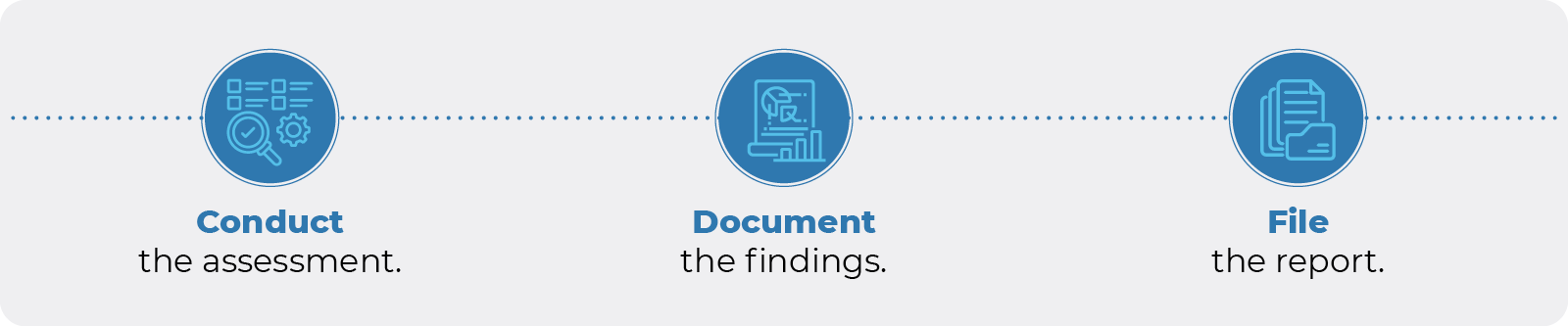
That approach once satisfied the basic expectation of the HIPAA Security Rule. But the regulatory landscape has evolved, and the standard for what constitutes effective risk management in healthcare has changed with it.
Today, regulators are no longer satisfied with the existence of a risk assessment alone. Increasingly, they are evaluating what organizations actually do with the results.
Completing the assessment is no longer the finish line. It is the starting point.
A Shift in Enforcement Expectations
The Office for Civil Rights, which enforces the HIPAA Security Rule, has gradually increased its scrutiny around how healthcare organizations conduct and use their Security Risk Assessments.
In recent years, OCR has launched targeted enforcement efforts focused specifically on the risk analysis requirement of the Security Rule. These initiatives were created to highlight what regulators have long emphasized: a thorough risk analysis is the foundation of an organization’s cybersecurity program and its ability to protect electronic protected health information (ePHI).¹
The message from regulators has become clearer with every investigation and settlement announcement. Conducting a risk assessment is required, but simply having one on file does not demonstrate compliance.
What regulators increasingly want to see is how the organization used the findings.
Did the assessment identify vulnerabilities?
Were those risks prioritized?
Were remediation steps documented and tracked?
And most importantly, were the issues actually addressed?
Without that follow-through, a risk assessment can quickly become little more than documentation.
Risk Analysis and Risk Management Go Hand in Hand
The HIPAA Security Rule has always required two closely related activities: risk analysis and risk management.² The first identifies vulnerabilities that could affect the confidentiality, integrity, or availability of protected health information. The second requires organizations to take steps to reduce those risks to a reasonable and appropriate level.
Historically, many healthcare organizations placed most of their emphasis on the analysis portion of the process. The assessment was completed, the documentation was retained, and the organization moved on to other priorities.
Today, that approach is increasingly difficult to defend.
Recent enforcement actions illustrate that regulators view the risk assessment not as a standalone exercise, but as the foundation of an ongoing security program. In fact, several enforcement actions tied to OCR’s Risk Analysis Initiative have centered on organizations that failed to conduct a sufficiently thorough assessment or failed to act on the risks they identified.³
In practical terms, that means an organization must be able to demonstrate not only that risks were identified, but that leadership made deliberate decisions about how those risks would be managed.
The Reality of Modern Healthcare Threats
This shift in regulatory expectations is happening against the backdrop of a rapidly evolving cyber threat landscape.
Healthcare organizations, particularly rural hospitals and critical access facilities, are increasingly targeted by cybercriminals who understand the operational challenges these providers face. Limited security staffing, aging infrastructure, and complex vendor ecosystems can create vulnerabilities that attackers are quick to exploit.
Ransomware and hacking incidents have become the leading drivers of large healthcare data breaches, pushing cybersecurity risk management to the forefront of regulatory and organizational priorities.⁴
In this environment, regulators are paying closer attention to whether healthcare organizations are taking reasonable steps to secure their environments. That includes examining whether risk assessments evaluate issues such as system configuration weaknesses, vendor dependencies, and emerging attack methods.
A risk assessment that does not reflect the realities of today’s threat environment may no longer be considered sufficient.
What Happens After a Breach
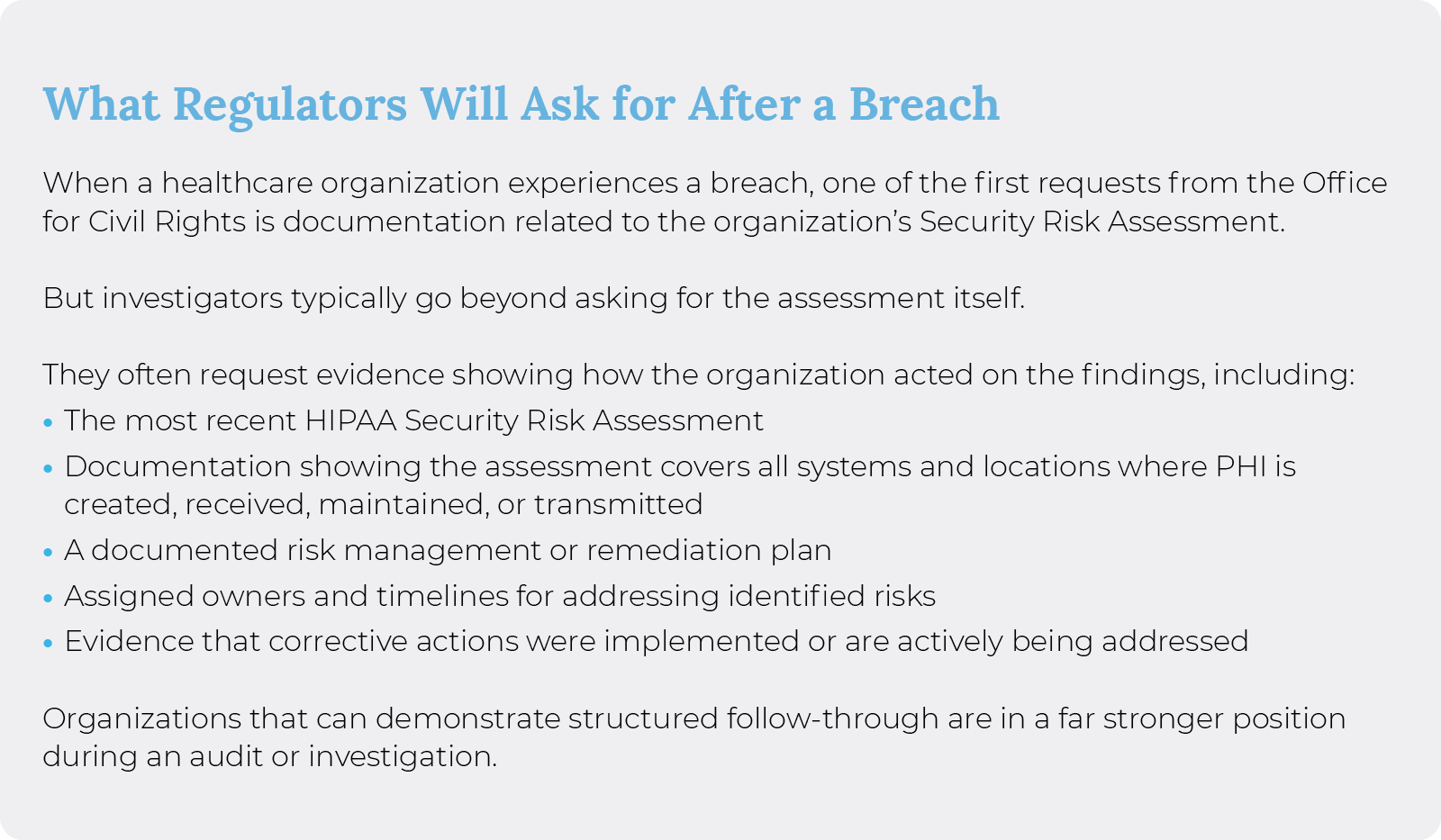
When a healthcare organization experiences a breach, regulators typically begin their investigation with documentation.
One of the first things investigators request is the organization’s most recent Security Risk Assessment. But the review rarely stops there.
Investigators often ask follow-up questions designed to understand how the organization managed the risks it identified. They may request documentation showing how vulnerabilities were prioritized, which corrective actions were assigned, and what progress has been made toward remediation.
In other words, the assessment itself becomes part of a broader narrative about how the organization approaches cybersecurity risk.
If a risk assessment identifies significant vulnerabilities but there is no evidence those issues were addressed, the organization may face increased regulatory scrutiny.
Turning the Assessment into a Strategic Tool
For healthcare organizations with limited resources, particularly rural and critical access hospitals, this evolving enforcement environment can feel daunting. But it also highlights the true purpose of the Security Risk Assessment.
A well-executed SRA should not simply produce a list of technical findings. It should provide leadership with a prioritized roadmap for improving the organization’s security posture over time.
When the results of the assessment are translated into a structured remediation plan—with clear priorities, ownership, and timelines, the SRA becomes far more than a compliance requirement. It becomes a strategic management tool.
It allows leadership to align security investments with risk exposure, communicate priorities to boards and regulators, and demonstrate that cybersecurity is being addressed in a disciplined, ongoing way.
From Assessment to Action
The regulatory message emerging from enforcement activity is clear: documentation alone is no longer enough.
Healthcare organizations are expected to demonstrate that they understand their risks, and that they are actively working to manage them.
Completing a Security Risk Assessment remains a critical step in that process. But its real value lies in what happens afterward.
Organizations that treat the SRA as a living roadmap—one that informs budgeting, prioritization, and security improvements throughout the year—are far better positioned to withstand both cyber threats and regulatory scrutiny.
In today’s environment, the difference between compliance and resilience often comes down to one thing: What happens after the assessment is complete.
REFERENCES
- HHS OCR Risk Analysis Initiative announcement
- Focus on enforcing the HIPAA Security Rule risk analysis provision. (HHS.gov)
- HIPAA Security Rule requirement for risk analysis
- 45 CFR §164.308(a)(1)(ii)(A). (The HIPAA Journal)
- Recent OCR enforcement actions tied to insufficient risk analysis
- Enforcement actions continue under the Risk Analysis Initiative. (mcdonaldhopkins.com)
- Growing ransomware pressure on healthcare organizations
- Increasing cyber threats drive stronger enforcement expectations. (Reuters)