
Operationalizing EDR, MDR, and SOC in Healthcare
 It’s 2:45 in the morning. A hospital’s endpoint detection and response (EDR) platform fires an alert; ransomware behavior is detected on a nurse’s workstation. What happens next explains everything about the maturity of its IT security program.
The average hospital-based healthcare IT team isn’t lacking security tools and dashboards. The problem is operationalization: turning the wealth of telemetry provided by the tools into meaningful, rapid action before a cyber threat affects patient safety and shuts down clinical operations.
For example, do you isolate the workstation? Does containment begin automatically, with human analysts reviewing a clean handoff an hour later? Or does the IT team spend that hour passing the baton: security calls IT, IT calls administration, administration calls the clinician, before anyone feels authorized to act? For most healthcare organizations, it’s the latter. And that delay is exactly what threat actors are counting on.
Tools Don’t Respond, Organizations Do
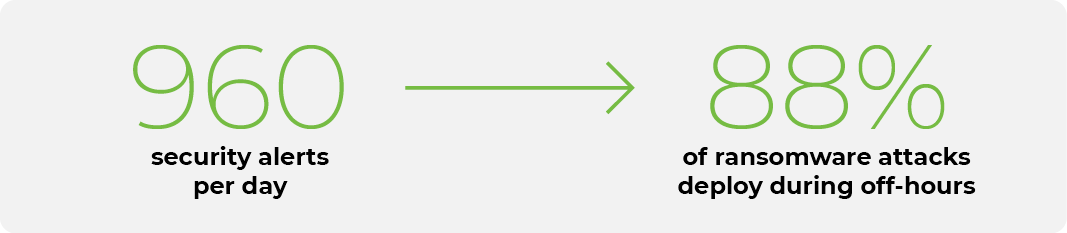
The numbers are hard to ignore. The average healthcare organization faces roughly 960 security alerts per day. Meanwhile, 88% of ransomware attacks deploy during off-hours.
Imagine walking in at 7:00 AM to find 400 alerts waiting to be reviewed. Somewhere in that stack is the critical alert that a nurse’s workstation triggered a ransomware alert at 2:45 AM.
Meanwhile, the ransomware spreads laterally. In healthcare, the financial and operational risks of this hesitation can be significant: an average day of healthcare downtime costs $1.9 million, and the average outage lasts 17 days.
Many healthcare IT teams are staffed lean, and sifting through nearly 1,000 daily alerts makes alert fatigue inevitable. An alert appears ten times, gets dismissed as a false positive, and drops off the radar. The 11th time is the one that brings the hospital down.
Throwing more tools at the problem is a common but insufficient response. Organizations that respond effectively to endpoint threats have built something more important than a tech stack: operational clarity before anything goes wrong.
Three Layers, One Program
Endpoint security in healthcare operates across three interconnected layers:
EDR (Endpoint Detection and Response) is the first line of defense. It provides visibility into what is happening on a device, such as behavioral anomalies, indicators of compromise, and more. It potentially provides the telemetry needed to isolate a device with the right context and authorization to act.
MDR (Managed Detection and Response) adds depth and human judgment. It correlates endpoint telemetry with network logs, identity events, cloud activity, and more, helping analysts determine whether an alert is legitimate and what the appropriate response should be.
SOC (Security Operations Center) is the connective element: the people, processes, and oversight that bring everything together and drive the bigger picture. In lean IT environments, all three layers may fall on the same person. That reality makes documented processes and pre-authorized playbooks even more critical.
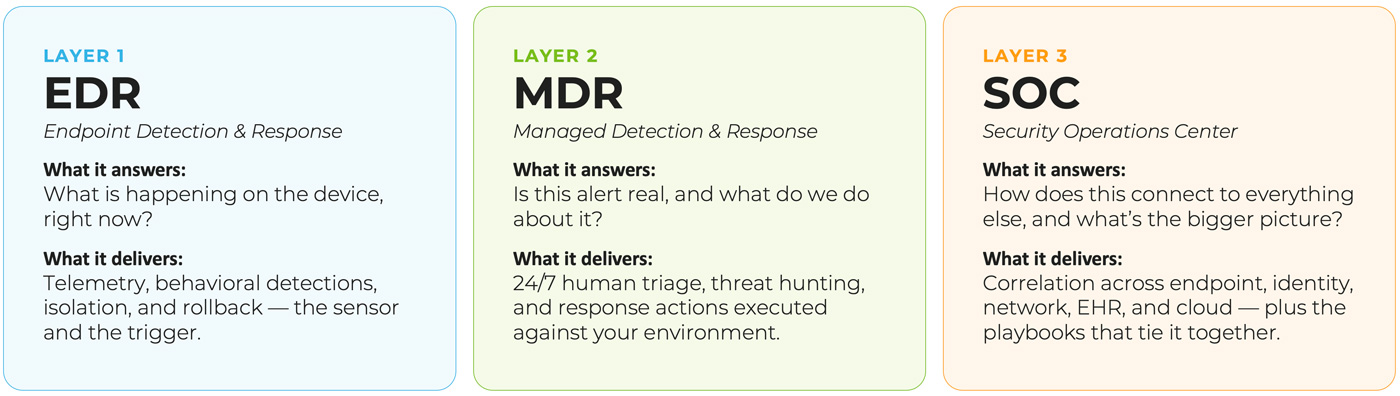
Three Layers of the Stack: EDR, MDR, and SOC
The Four Strategic Pillars of Success
Four pillars make this interconnected stack work, acting as the strategic foundation that turns EDR, MDR, and SOC into a program that actually responds:
1. Focus on hygiene and standardization. The state of the healthcare IT environment before an event determines how effective a response will be. Scale is ultimately a measure of visibility. An endpoint that isn’t visible cannot be defended. That means consistent asset labeling, visibility into endpoint coverage, and knowing with confidence what is on the network and what it does.
2. Structured triage with clear ownership. Automation is often positioned as the answer to alert fatigue, but automation without ownership only creates faster confusion. Repeatable workflows boil down to clear ownership. Who owns the response? Who is authorized to isolate an endpoint at 3 AM without waiting for an escalation chain? These decisions need to be documented, tested, and agreed upon before the alert fires.
Playbooks also must be resource-agnostic. If the primary security person is unavailable, the documented workflow must allow whoever is on call to step in and execute flawlessly.
3. Clinical impact awareness. Healthcare security is different than corporate IT. Every containment decision carries a clinical variable. Every endpoint action must balance cyber threats against the realities of clinical operations. Isolating a sys admin workstation is straightforward. Isolating a device connected to infusion pumps is not.
4. Context as the foundation of response. An alert is just data; context dictates the response. The same alert can mean entirely different things depending on who the affected user is, what the device does, and when the event occurs.
A malware detection on a billing workstation at 2 AM warrants a different response than the same detection on a service account that controls downstream clinical integrations. Context gathered before an event is exponentially more valuable than context assembled during one.
If an EDR flags malicious activity on a system, the response changes based on identity and role:
- Sys Admin Account: High risk of domain-wide privilege escalation. Action: Disable the account and isolate it immediately.
- Clinician Endpoint: High risk of disrupting patient care. Action: Targeted containment and immediate escalation to clinical leadership.
- Service Account: High risk of downstream integration failures that might not show up for days. Action: Rotate credentials and assess the blast radius carefully.
Asset Labels Are Not Just Inventory Items
Every endpoint in healthcare carries different risks. One of the most underappreciated drivers of effective response is asset classification. When a SOC analyst receives alerts from two systems simultaneously, one a conference room PC and one a pharmacy workstation, the label is what determines which one gets priority attention first. Without it, both appear as medium-severity alerts, and response teams waste critical minutes trying to determine what a device does before deciding whether it is safe to isolate.
A tiered classification model helps. Tier 1, life-critical systems (infusion pumps, ventilators, clinical monitoring) require clinical approval before any isolation action. Tier 2, clinical operations systems, may support auto-isolation with immediate unit lead notification and a defined SLA. Tier 3 business operations systems can follow standard automated playbooks without escalation. These tiers help provide the logic that automated response and analyst workflows run on.
What “Operationalized” Actually Looks Like
An operationalized program is built on four questions answered long before an incident occurs:
- Who owns the response? (IT, clinical, an outsourced team, or the SOC analyst?)
- What can you safely take offline?
- Who is authorized to make the call at 3:00 AM?
- When was this last rehearsed?
Triage isn’t one person working through a list. It’s a system in which the hard decisions are made before anything goes wrong.
So, what does an operationalized program look like in practice? Let’s look at an ideal, pre-planned response, an “all green light” scenario. An EDR flags a suspicious shell execution and fires an alert at 2:00 AM. An automated enrichment pipeline identifies the asset and user from directory services integrations and asset management systems. It is a Tier 3 billing admin endpoint.
This context allows the playbook to automatically elevate the severity. Because the administration granted previous authorization for Tier 3 auto-isolation, the playbook executes and triggers containment. The machine is taken offline before the attacker can move laterally. By the time a human analyst reviews the case, the threat is already contained. It reimages the machine in the morning. No additional approvals were needed, patient care was not disrupted, no doors were left unlocked, and there was no confusion about ownership and escalation chains. No dropped batons.
This is achievable, but only with the groundwork already in place: pre-authorized isolation actions for specific asset tiers, explicit handoffs between containment and incident response, and playbooks that hold up regardless of who is on call.
Elevating from EDR to MDR: The Bigger Picture
Endpoints are only the first step. An infected workstation is just a foothold. Where the attacker goes next depends on which doors are closed across the rest of the network, such as EHR and application layers, identity (Active Directory), and cloud and hosted layers.
Manually hopping between five to 20 different security tools during an active breach is a nightmare. This is where an MDR service over the top of the IT security infrastructure acts as a master aggregator (SIEM), correlating telemetry and intelligent event correlation into a single pane of glass for rapid containment and quicker remediation.
Furthermore, healthcare environments are full of medical IoT devices (infusion pumps, ventilators) that cannot run standard EDR agents due to vendor restrictions or FDA regulations. An operationalized program addresses this by placing these legacy devices in protected, controlled network zones, so a compromised laptop can’t access patient-facing systems.
The Metrics That Matter Most
Healthcare organizations must measure security programs differently from other industries. Mean time to contain matters, but so do clinical disruption minutes; the measure of how much patient care was affected by both the attack and the response to it. If a security action causes patient diversion or delays elective procedures, that is not a win, regardless of how quickly the threat was contained. Security is a clinical uptime function; operationalized programs measure themselves on patient outcomes, not just dwell time.
To measure the true maturity of a healthcare IT security program, focus on these four metrics:
- Speed: Mean Time to Contain (MTTC), not just time to detect.
- Scale: The percentage of actual assets covered and accounted for.
- Safety: Total clinical disruption minutes incurred during an incident.
- Readiness: The frequency and success of your live tabletop exercises.
This extends to areas often overlooked in endpoint programs, such as joint governance between clinical leadership and IT security, and documented downtime procedures that enable clinical staff to maintain safe care delivery during an outage.
A Closing Reminder: Test Before You Need It
Almost every IT security leader has heard some version of this: an organization that had never tested a backup restore discovering its backups were corrupted during an actual disaster. The same principle applies here. Tabletop exercises, incident response walkthroughs with clinical teams, and regular rehearsals of isolation and escalation procedures become the mechanism by which paper plans become muscle memory.
The first time a team opens the incident response playbook should not be during a live ransomware event. Speed is what separates detecting an attack from containing one. But speed only comes from having done the work long before the alert fires.
Interested in learning more about how to operationalize your EDR, MDR, and SOC? Listen to our on-demand webinar, Running Endpoint Security at Scale.